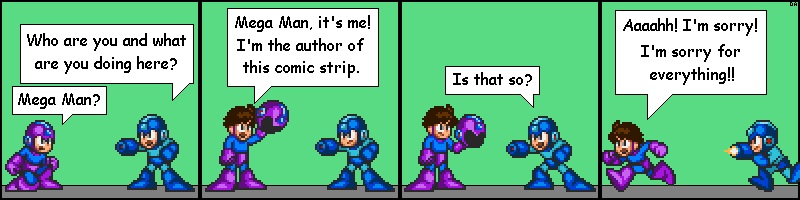
Personally, I enjoy working with 16-bit sprites the most. 8-bit sprites are too simplistic, while 32-bit sprites are too complicated. 16-bit sprites are simple enough to work with, but complex enough that they look nice, a happy medium between the two extremes. So when given the chance, I would revert back to 16-bit sprites at my earliest convenience. In fact, it was always a pleasant surprise to go back to 16-bit sprites after I had been working with other bittages for a while, such as with one of the game parodies.
By the way, for those of you who have no idea what I'm talking about with all this 8/16/32-bit stuff, allow me to explain. During the time of the Super Nintendo and Sega Genesis, when game consoles tried to describe how powerful they were, they would often talk about how powerful their CPUs were and how much information they could process, or something to that effect. This gave rise to the idea that both systems were "16-bit", in that the systems could use 16-bit memory addresses, though exactly what in the system used those addresses was not necessarily clear or standardized. The less advanced original NES was then "8-bit" while more advanced systems, like the Sony Playstation, was considered "32-bit". While this usage died off soon after the release of the Nintendo 64 (a "64-bit" system) and consoles started using other benchmarks to describe how powerful they are, it is still handy to use those designations for the sprites from that time period.
|